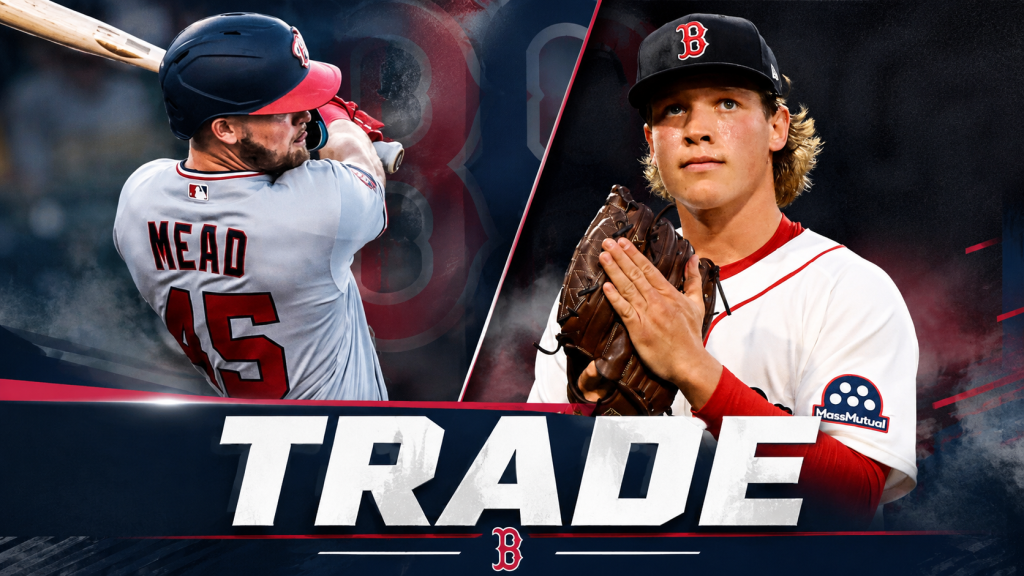


With just over a week to spare before the August 3 Trade Deadline, Craig Breslow made his first real move of the summer. Boston completed a Curtis Mead trade, shipping rookie left-hander Connelly Early to Washington for the infielder. I’ll admit it: when I first saw this trade, I hated it. Early is a young, talented lefty who’s shown some real upside, and we were giving him up for a player I had barely even heard of, that is already joining his fourth MLB team. But then I looked into Mead a little more, and my opinion started to change. Let’s get into what the Statcast data actually says about both guys, and I’ll lay out my own theory for why the Red Sox did this and where Mead fits into this lineup every day.
Connelly Early: A Deeper Look
Let’s start with what Boston gave up. Early limited hard contact well below average (33rd percentile Hard-Hit%) and got hitters to chase at a healthy 31.4% clip. But dig a little deeper and the picture gets more mixed. His fastball sat at 93.4 mph, just the 31st percentile league-wide, not exactly the kind of velocity that makes scouts salivate, and his xERA came in at a 40th-percentile 4.33. His overall run value was right around average, 43rd percentile, which tells me this is a pitcher succeeding more on mix and deception than pure stuff. One number worth flagging, though: he’s given up 15 home runs across 91.2 innings this season, a rate of right around 1.5 per nine, and more than half of those (8 of 15) were the no-doubt kind, not cheap ones that snuck out. Statcast’s model expected almost the same total (14.3 xHR), so this isn’t bad luck catching up to him, it’s a real fly-ball tendency that’s worth watching.
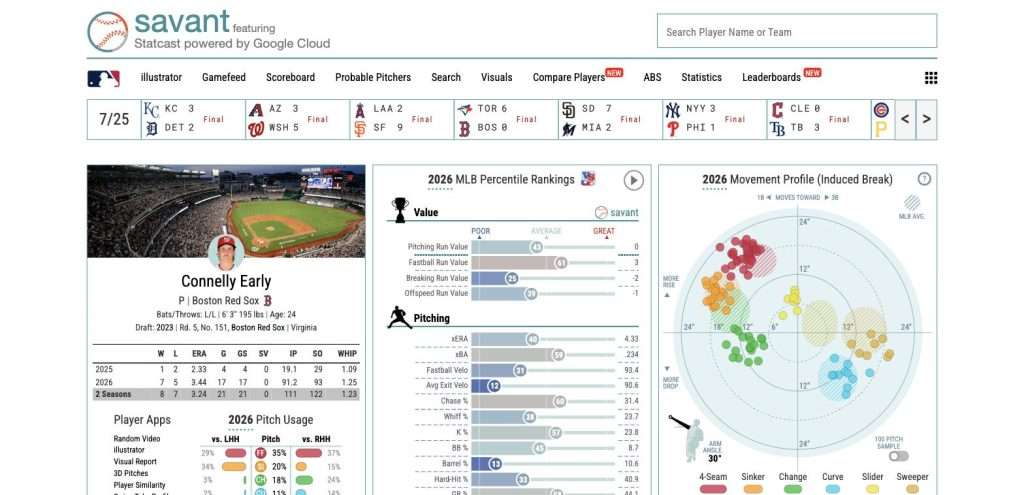
That mix and deception instead of pure stuff analysis also shows up in his movement profile too. Tight, above-average shape on the four-seamer, and a distinct sinker/changeup pairing that generates weak contact more than empty swings. That’s a solid foundation for a starter who eats innings, but it’s a lower ceiling than the true swing-and-miss arms teams usually protect and hold on to.
Curtis Mead Trade Grade: A Statcast Snapshot
Now here’s where this trade gets interesting for me. Mead’s offensive profile is legitimately impressive. His .359 xwOBA ranks in the 85th percentile of all big-league hitters, backed by a 79th-percentile xSLG (.462) and a 70th-percentile xBA (.262). His barrel rate (72nd percentile) and chase rate (76th percentile) both point to a guy who’s squaring up quality pitches and controlling the strike zone. The one number that gives me pause is his average exit velocity, just the 31st percentile, which tells me the power is coming more from bat path and sweet-spot contact than from elite raw strength.
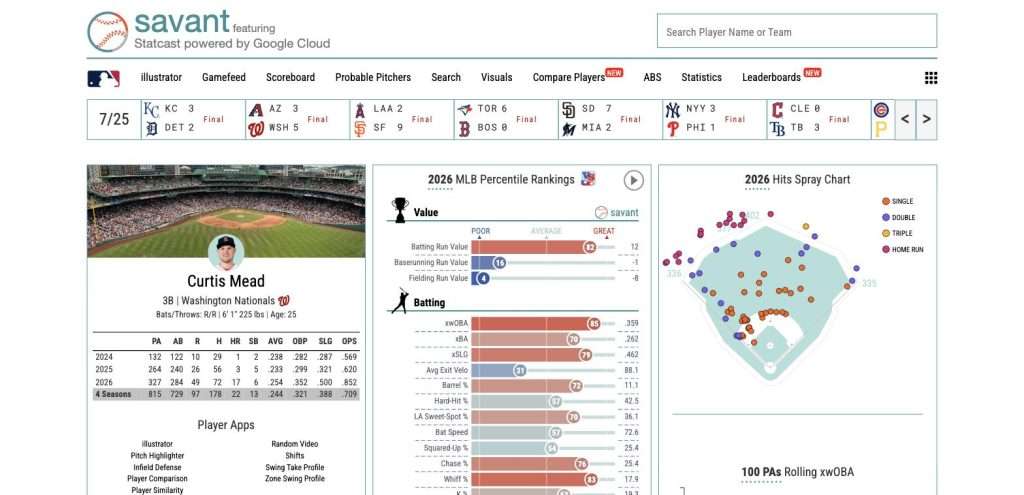
The spray chart backs up that read. Mead is peppering both gaps and pulling the ball with real authority, and this isn’t a guy selling out for pull-side power. He’s using the whole field, and that usually means the performance is more sustainable than a three-week hot streak.
Hypothesis: Where Does Mead Fit Every Day?
This is the part I keep coming back to, because it isn’t as simple as just handing Mead his old position. Willson Contreras is locked in at first base, and Caleb Durbin has quietly turned into one of the better defensive third basemen in the American League this season. I don’t see Boston moving him off the spot. Mead has already logged 41 games at third, 19 at first and one at second for Washington this year, so he’s not walking in as a one-position guy. He’s arriving with real versatility.
My hypothesis? Second base and designated hitter are the two spots on this roster that have produced the least all season, and I’d bet that’s exactly where Breslow envisions Mead becoming an everyday presence, probably some kind of personal platoon or rotation between the two rather than one fixed job. I’d expect early usage to lean toward DH days against right-handed pitching, where his exit-velocity limitations matter less against pitches he can drive, mixed with starts at second base to keep his bat in the lineup without touching Durbin’s Gold Glove-caliber work at third. And if Durbin ever needs a breather, Mead’s third-base reps in Washington give Boston a clean fallback option there too.
My Take: Grading the Curtis Mead Trade
I hate giving up young arms, especially left-handed ones, but Breslow has shown that building a rotation is a strength of his. Mead has struggled in in the big leagues prior to this season, so the hope and the bet that Breslow is making is that this season is his breakout.
If it in fact is, Breslow just addressed this team’s most obvious weakness, its home run total, with a bat that Statcast says is performing like a top-of-the-order threat, not a complementary piece. If Mead’s plate discipline holds up in Boston the way it has in Washington, I think this could end up looking like a great trade for the Red Sox.
I’ll admit that while I’m okay with this trade, part of me was hoping Early would end up as a piece in a bigger, more impactful deal. We’ll see what else Breslow does before the August 3rd deadline, but on its own, this move gives Boston a better bat to add to his lineup, and that makes it a worthwhile bet.
About The Author