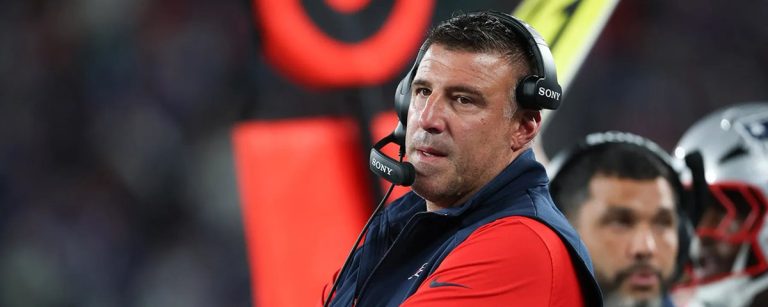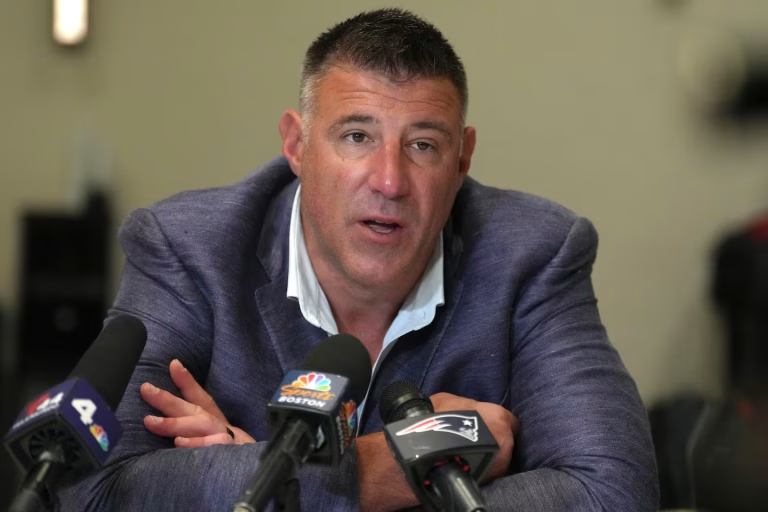
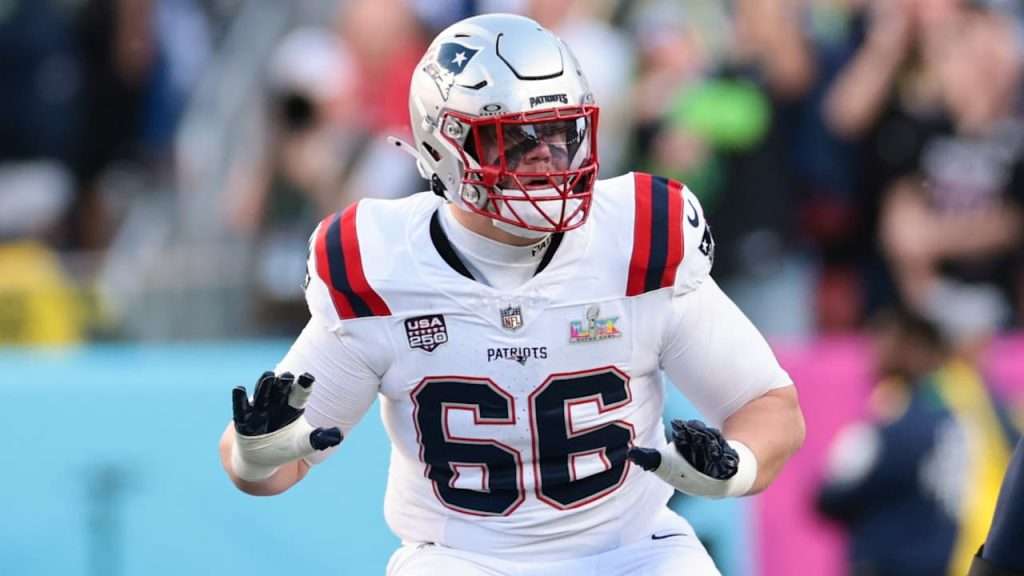

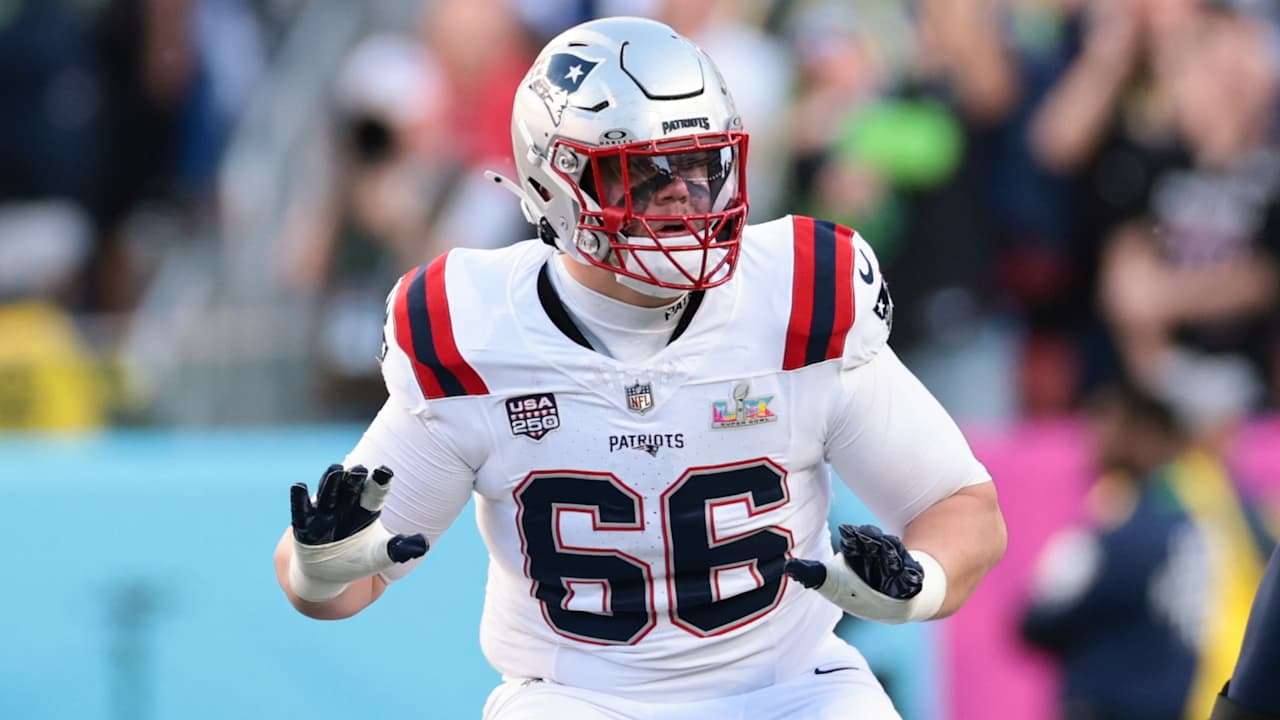
One torn MCL, one Super Bowl beatdown, and a fan base that decided Will Campbell has short arms and has never stopped saying so for fifteen months.
Somewhere on the internet right now, someone is six replies deep into their own tweet, arguing with strangers who haven’t even shown up yet. He cannot tell you what a jump set is. He could not diagram a T-set to save his life. But he knows, with the confidence of a man quote-tweeting himself for the third time today, that Will Campbell is actually a guard, that the Patriots front office knows it too, and that the only reason Campbell is still lined up at left tackle is a conspiracy to protect a top-five pick’s ego instead of doing what’s actually best for the offense.
That’s where we are with Will Campbell. One full rookie season, a Super Bowl appearance, a torn knee ligament, and a second first-round tackle drafted a year later, and the sport’s most polarizing 22-year-old lineman is still getting adjudicated in group chats like he’s on trial for a crime nobody can quite name.
Let’s back up.
How We Got Here
New England took Campbell fourth overall in the 2025 draft, the highest a Patriots offensive lineman had gone in decades, out of LSU, where he started all 38 games of his college career at left tackle and picked up back-to-back First-Team All-SEC honors. The pick was billed as the cornerstone move of the Mike Vrabel era: draft the best player available, put him at the most important non-quarterback position on the offense, and build out from there.
The reaction split almost instantly into two camps, and both showed up before Campbell had played a single competitive snap. Camp one said New England had landed a foundational left tackle who’d anchor the line for a decade. Camp two fixated on one number from the pre-draft process, his arm length, and decided the whole thing was doomed before he’d taken a snap.
That arm length number is worth taking seriously, because it’s a real scouting variable and not just internet noise. Will Campbell measured 32 5/8 inches at the combine, below the 33-to-34-inch range teams traditionally like at tackle, before a remeasurement at LSU’s pro day bumped him to 33 inches even. Campbell, understandably, called the whole saga overblown. Shorter arms can be a legitimate technical problem. They shrink the margin for error in pass protection, they make it easier for edge rushers to get into a blocker’s chest before he can extend, and there’s a real historical pattern of shorter-armed tackles sliding inside to guard.
All of that is true. None of it means a player with 33-inch arms is constitutionally barred from playing left tackle. Arm length is one input in a scouting profile that also includes footwork, get-off, anchor strength, play strength, processing speed and, you know, actual game tape. Treating it as the whole report is like judging a quarterback exclusively by hand size and ignoring that he also throws touchdowns.
What Will Campbell Actually Did in His Rookie Season
The popular opinion right now is that Will Campbell simply can’t play left tackle in the NFL, and the case for that take usually starts and ends with three games: the divisional round, the AFC Championship, and a Super Bowl where he allowed a season-worst pressure count on the league’s biggest stage. That stretch happened, and it was ugly. But building a verdict on a rookie’s worst three weeks while ignoring the other fourteen games is its own kind of narrative laundering. The honest version requires splitting the season in half.
Before the injury, Campbell was genuinely excellent. PFF had him as one of its highest-graded rookies at any position through the season’s first seven weeks, and the weekly tracking backs it up: a stretch in October where he ranked among the top two rookie tackles in the league in both pass- and run-blocking grade and a Week 4 outing against Carolina where he didn’t allow a single pressure, hurry, hit or sack had Patriots fans convinced they’d hit a home-run pick at tackle. The arm-length doom-scenario simply wasn’t showing up on tape. His issues, when they existed, were rookie issues: occasional hand-placement lapses, a tendency to get too grabby against elite bend rushers, and a run game that lagged behind his pass protection.
Then, on November 23 against Cincinnati, he tore his right MCL. Vrabel initially downplayed the severity, then the team placed him on injured reserve days later. He missed four games. At the moment he got hurt, PFF had him ranked 27th among 77 qualified tackles with a grade north of 70 both overall and in pass protection, meaning even after a natural second-quarter-of-the-season dip, he was still comfortably above the replacement-level line teams use to separate starters from problems.
The return is the part that actually fueled the backlash, and it’s fair to interrogate it rather than wave it away. Campbell came back for the stretch run and the playoffs still working his way back into game shape, and the tape showed it. New England went on a run to Super Bowl LX behind a 10-7 AFC Championship win over Denver, but Campbell’s individual performances got progressively uglier as the games got bigger. In the divisional-round, he produced a pass-blocking grade in the low 60s with five pressures allowed and a sack that turned into a fumble, prompting a wave of criticism. Then came the Super Bowl itself, a 29-13 loss to Seattle. Next Gen Stats charged Campbell with 14 quarterback pressures allowed in that game alone, the most by any player in a single game all year. PFF’s own count for the same game was considerably lower, eight pressures on 57 pass-block snaps, still enough to produce a rough-looking 32.9 pass-block grade. Two respected tracking services, two very different numbers, both bad. That gap matters, because it’s a reminder that “pressures allowed” isn’t one clean, universally agreed-upon stat, whether it’s PFF’s charting, Next Gen’s algorithm, or whatever a Reddit thread decided to hand-count off the broadcast copy.
Add it up for the full season and Campbell finished with a 72.6 overall PFF grade, 32nd among 89 qualified tackles, with a 76.1 pass-blocking grade (23rd) that meaningfully outpaced a 67.7 run-blocking grade (39th). Those numbers include his disastrous playoffs. The brutal three-game playoff stretch dragged his box-score numbers down, but it didn’t actually crater his standing among his position group nearly as much as the vibes would suggest.
Was it the Injury or a Rookie Wall?
Both, and it’s worth being honest about the split instead of picking a side. At the NFL Combine in February, Patriots executive vice president of player personnel Eliot Wolf told reporters the injury had a trickle-down effect, explaining that Campbell lost lower-body power and strength after tearing the MCL, and that three of his four worst games of the season came during that compromised postseason stretch, including the Super Bowl. No surgery was required, and the offseason plan centered on rebuilding that lower-half strength. That’s the organization, on the record, attributing the worst of the collapse to the knee rather than to some permanent limitation tied to his arms.
But it would be lazy to pin all of it on the injury. It’s also worth remembering he was doing something he’d never done before: playing a full NFL season. Campbell’s three years at LSU topped out at 13 games, in a 2023 slate that included a bowl trip. As a rookie, between his 13 regular-season starts and the Patriots’ four-game run through the playoffs to Super Bowl LX, he played in 17 games. That’s more football in one year than he’d ever played in his life, wrapped around a knee injury that cost him a month. PFF’s own midseason retrospective showed Campbell’s grade sliding some even before Week 12, the normal cost of a rookie left tackle seeing more disguised looks and better rush plans as the year wore on. All that, combined with the injury, and his poor performance after he returned in the playoffs gave fans a short-sighted view of Campbell as a prospect and his season as a whole.
Then the Patriots Drafted Caleb Lomu
Right on cue, New England spent its first-round pick in April on Utah tackle Caleb Lomu, and the discourse machine did what it always does: assumed the worst, loudest possible version of events. Lomu measured in at nearly 6-foot-6, 313 pounds, with 33 3/8-inch arms and an 82 3/4-inch wingspan, and Patriots.com’s own draft coverage noted he checks the traditional boxes for a first-round tackle. Cue a fresh round of fans ready to hand him the left tackle job on the spot.
Except a few evaluators pumped the brakes on that exact framing. Rams.com’s pre-draft breakdown flagged Lomu’s arms as in the 23rd percentile at the position, with hand size even further down, and floated him as a candidate to eventually kick inside. Athlon Sports made the same point at the combine, noting his arms sit below the positional mean. In other words, the guy some fans want installed as the long-armed antidote to Campbell has arms that are, by raw inches, only about three-eighths longer, and by percentile, still on the shorter side for the position himself. If short arms are truly an automatic disqualifier, somebody should tell Utah’s cleanest pass protector in the draft class, who didn’t allow a sack all season on 359 pass-block snaps.
More importantly, nothing the Patriots have actually done points toward Lomu taking Campbell’s job. On draft night, Wolf was directly asked about it and said, in essence, that Campbell is the left tackle and Lomu brings versatility. Through OTAs, minicamp and into camp, Vrabel has lined Lomu up almost exclusively at right tackle behind veteran Morgan Moses, with reps mixed in at at Left Tackle and even Guard. The Patriots like Lomu and that’s why they drafted him. They are having him workout mainly at Right Tackle because internally that’s what they view him as, their Right Tackle of the future.
What We’re Actually Seeing in 2026
And what the Patriots are actually getting from Campbell early in camp is, by all accounts, encouraging. New left guard Alijah Vera-Tucker, who lines up next to him every snap, has praised his football intelligence and predicted a real second-year leap. Dre’Mont Jones, the Patriots’ notable free-agent pass-rush addition who lined up across from Campbell as an opponent last season, said flatly that Campbell has gotten better since the last time they faced off.
Reporters covering camp have noted Campbell winning the bulk of his one-on-one reps against the Patriots’ pass rush, including a strong showing in the very first one-on-one period of camp, and multiple beat writers have used words like “transformation” to describe the jump from his rookie tape to what he’s showing now. He spent the offseason working out with Eagles great Lane Johnson, which isn’t nothing.
Worth separating two different claims here, though. “Will Campbell is having a great camp” is well-supported by the reporting. “Will Campbell has proven he’s a lock to be an elite NFL left tackle” is not a sentence anyone can honestly write in early August. Camp reps against a team’s own pass rush, useful as they are for gauging technique and conditioning, are not the same evidentiary standard as live snaps against a schedule of NFL edge rushers trying to end your quarterback’s season, but all signs entering 2026 so far are encouraging.
The Patriots Have Already Told us Their Plan for Will Campbell
Which brings us to the actual bottom line, not the group-chat version. Vrabel and Wolf drafted Campbell fourth overall, started him at left tackle as a rookie, backed him publicly through a rough playoff stretch, explained away a chunk of that stretch as injury-driven rather than talent-driven, and then spent draft night explicitly reaffirming that he’s their left tackle even while adding another talented tackle prospect. Barring reporting that says otherwise, and there isn’t any right now, that’s about as clear an organizational stance as you’re going to get in a sport built on coach-speak.
If Lomu develops into the kind of player who forces a real conversation, that’s not a crisis. That’s the best problem an offensive line coach can have. If Campbell instead stalls out or Lomu simply outplays him, Vrabel can and should move players around to put the best five up front, no matter what pick number is attached to anybody’s name and in that unlikely scenario, I trust Vrabel to do that. Nobody should confuse loyalty to a draft slot with good roster building.
None of that has happened yet. What’s happened is a rookie season that got flattened by the internet into a tidy little story, “t-rex arms, coddling him, bust of a pick,” when the real version involves a top-10 rookie grade through Week 7, a knee injury that derailed him at the worst possible time, a Super Bowl performance against a defense that would make anyone look overmatched, and a training camp full of teammates and coaches saying the arrow is pointing up. Maybe it doesn’t hold. Second seasons are real, and Lomu could give the Patriots a legitimate answer if this all goes sideways. But it might be worth letting Will Campbell actually play the position before we bury him over trying to come back too soon for his team and the length of his arms.
About The Author