
It’s been a couple of weeks since my first Patriots mock draft, where I worked through four rounds using PFF’s Mock Draft Simulator. This time around, I decided to switch things up and run the exercise through Pro Football Network’s simulator instead. One notable difference you’ll notice right away: I made no trades in this mock. Given how active the Patriots tend to be on draft weekend, that’s admittedly an unrealistic constraint — but it’s a useful exercise nonetheless.
Since my last mock, the Patriots’ roster has remained relatively stable. The core needs I outlined previously — WR, EDGE, LB, TE, and Safety — all still apply. I’m also continuing to operate under the assumption that an AJ Brown trade to New England is happening, and I’ve factored that into my thought process throughout.
With that framework in place, let’s get into it.
Round 1: Anchoring the Offensive Line
One of the more notable differences from my last mock is what happened at the top of the board. In my four-round mock, I selected OT Caleb Lomu with the 31st pick. Here, he went 11th overall to the Miami Dolphins — which, candidly, feels like a significant reach relative to where I’ve seen him projected elsewhere. The tackle market has also thinned considerably, with Francis Mauigoa, Monroe Freeling, Spencer Fano, Kadyn Proctor, and Blake Miller all off the board.
As was the case in my first mock, I’m weighing this pick between tackle and EDGE. On the offensive line side, Max Iheanachor — who Patriots fans may remember from his showing at Mike Vrabel’s Arizona State pro day — is the only tackle remaining that I’d genuinely consider. At EDGE, there’s still solid depth with TJ Parker, Malachi Lawrence, Zion Young, and Cashius Howell available.
I remain high on the EDGE class in this draft, but with the tackle board thinned out, I’m going with Max Iheanachor.
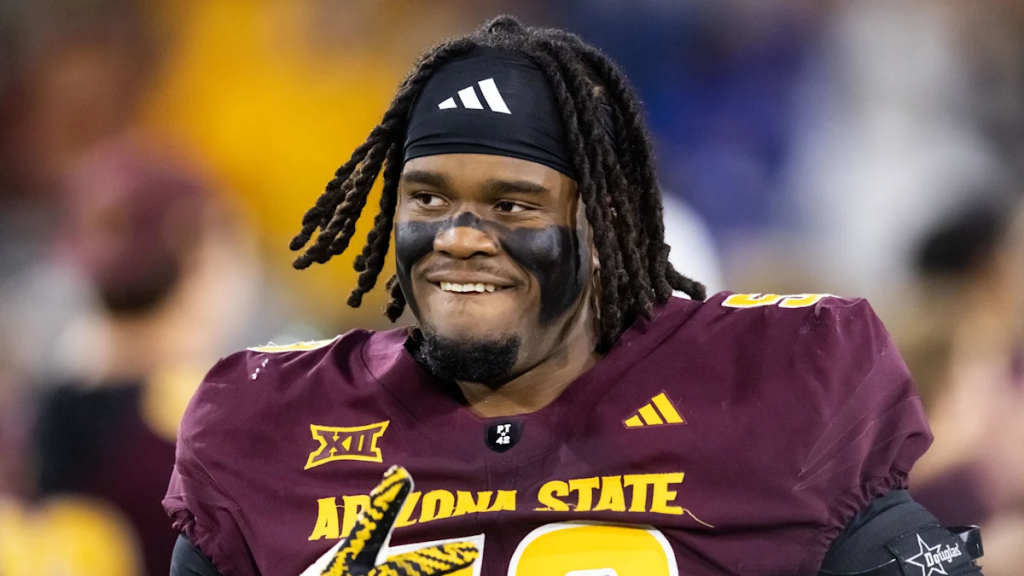
I had my eye on Iheanachor during my last mock as well — he felt like a natural fit for New England — but he came off the board at 24th overall before I had the chance. At 6’6″, 330 lbs with 34.5-inch arms, he checks every box evaluators look for in a tackle prospect. Pair those measurables with his quickness (impressive for a player of his size), his pass protection ability, and an edge to his game, and you have the profile the Patriots should covet.
It’s also worth noting that Iheanachor only began playing football in 2021, meaning there’s meaningful development still ahead of him — particularly in the run game. With Morgan Moses, 35, projected as the starting right tackle, drafting Iheanachor to serve as a high-value swing tackle while he learns and develops — then steps in as Moses’s successor in 2027 — represents a compelling succession plan that was too good to pass up.
Round 2: A Versatile Weapon at Tight End
Staying on the offensive side of the ball in the second round, I’m selecting TE Eli Stowers out of Vanderbilt.
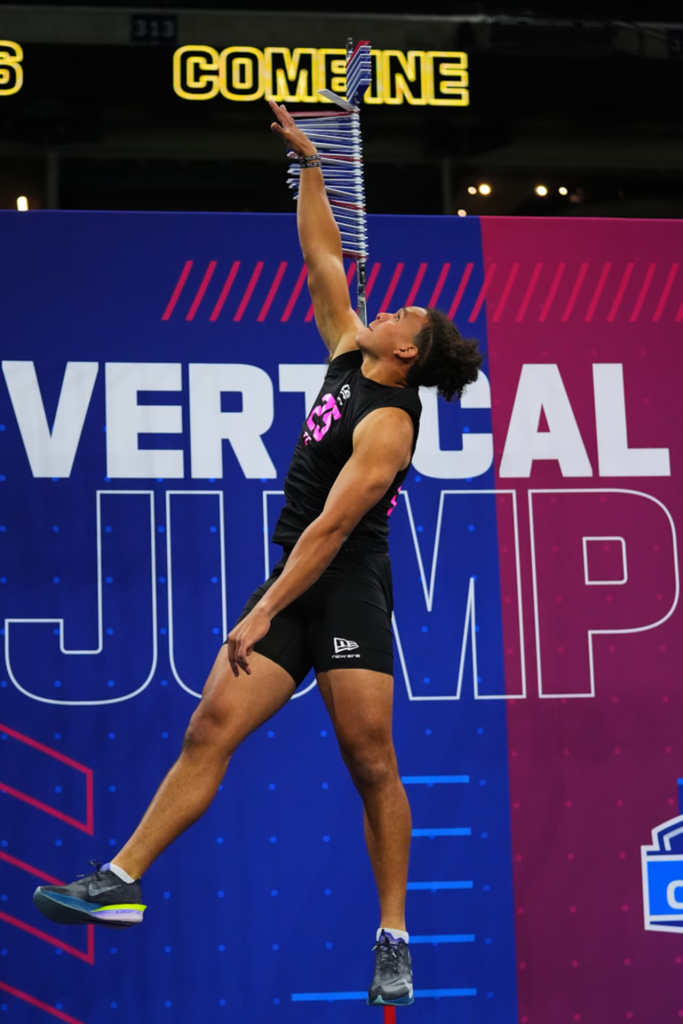
Stowers is 6’4″ and an explosive athlete whose stock has risen sharply after a standout NFL Combine performance, where he set the record for tight ends in the vertical jump. He moves much more like a big wide receiver than a traditional tight end, and he would give Drake Maye another dynamic pass-catcher capable of creating genuine mismatches against linebackers and safeties. His natural hands, catch radius, and strong yards-after-catch ability give him real big-play upside.
There is a learning curve to acknowledge. Stowers made the switch to tight end after spending the 2021 and 2022 seasons as a quarterback at Texas A&M, so his blocking game still has room to grow. He’ll need to be deployed primarily as a receiving threat early in his career. That said, with Julian Hill signed to handle blocking responsibilities and Hunter Henry returning, Stowers’s upside as a pass-catcher feels well worth the investment. I also think Josh McDaniels would have a field day designing plays around a converted quarterback with Stowers’s athletic profile.
Round 3: Injecting Pass-Rush Upside
At pick 95, I’m turning attention to the defensive side of the ball and selecting EDGE rusher Keyron Crawford out of Auburn.
Crawford’s path to this point is worth understanding. Like several of my selections in this mock, he’s a relatively inexperienced player — he only began playing football in 2021 after transitioning from basketball in his senior year of high school. But the growth he’s shown each season has been undeniable. This past year at Auburn, he put it all together: named a team captain, he finished with 36 tackles (9.5 for loss), 5 sacks, an interception, and a fumble recovery.
Crawford brings the traits New England covets — an explosive first step off the snap, physical play, a high motor, and the versatility to drop into coverage when needed. Yes, he’s undersized for the position, and his relative inexperience at the position means there’s development required. But the trajectory is encouraging, and his ceiling as a pass rusher is worth a third-round investment. In his first season, I’d expect him to contribute behind projected starters Harold Landry and Dre’Mont Jones — particularly on passing downs.
Round 4: Developing the Secondary
At pick 125, I’m selecting Safety Zakee Wheatley from Penn State — and I’ll admit some surprise that he lasted this long. In my last mock, I had him squarely on my radar at pick 95.
Wheatley is a tall, athletic safety with the range and closing speed to cover a lot of ground. He’s taken meaningful strides in coverage and is consistently strong when reading the run. There’s still room to add some bulk to his frame, and he continues to develop, but the tools are clearly there. The opportunity to spend a season learning from and playing behind Kevin Byard makes this an especially appealing development situation for a player with his profile.
Round 4 (Cont.): Giving Drake Maye Another Weapon
At pick 131, I’m returning to the offense and selecting wide receiver De’Zhaun Stribling out of Ole Miss.
Stribling’s trajectory over his college career has been impressive, and he consistently shows up in the biggest moments — including two performances against Georgia this past season: three catches for 96 yards and a touchdown in the regular season, and seven catches for 122 yards in the College Football Playoff. At 6’2″, he’s a polished route runner with strong hands and the ability to track deep balls over his shoulder — a trait that pairs naturally with Drake Maye’s arm. It’s also worth noting that Stribling is one of two wide receivers the Patriots brought in for a Top 30 visit, which signals genuine organizational interest.
Round 5: Building Depth at Running Back
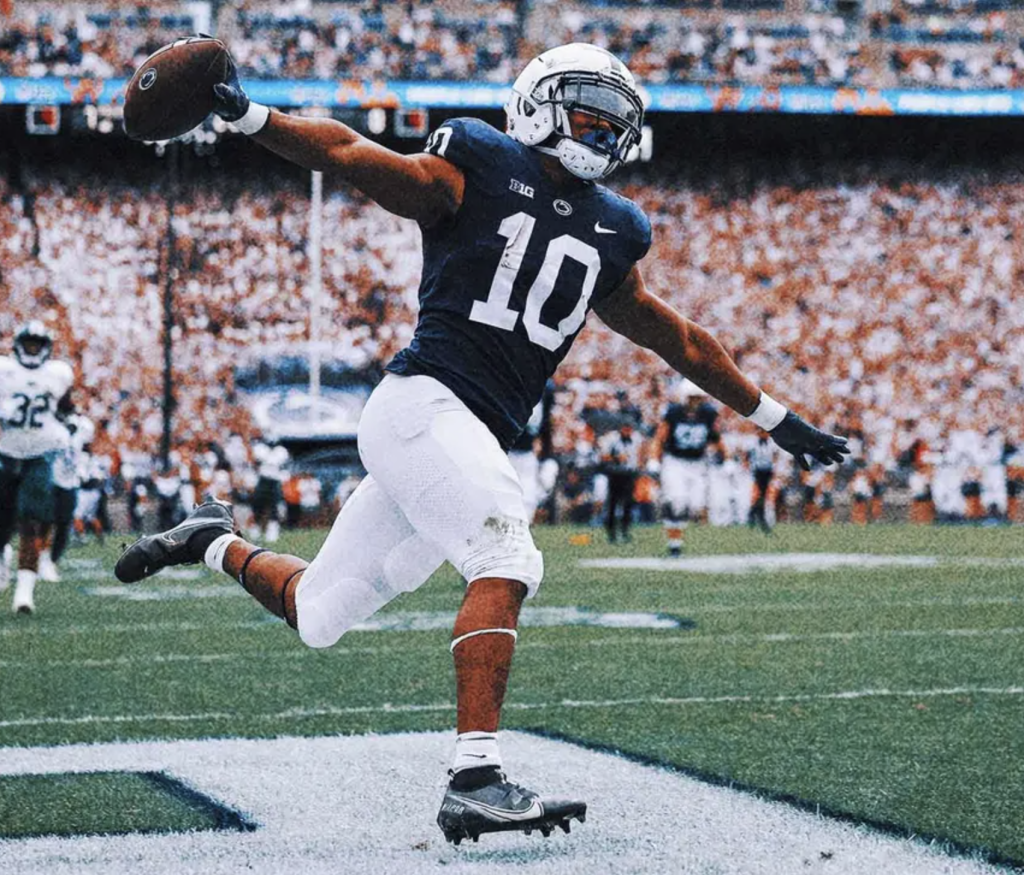
At pick 171, I’m addressing the running back room with Penn State’s Nicholas Singleton.
New England currently lacks a clear third option behind Rhamondre Stevenson and second-year back Tre’Veyon Henderson. With Stevenson approaching 30, adding young depth feels prudent. Singleton capped his senior season as Penn State’s all-time leader in total touchdowns (55) and all-purpose yards (5,586), combining power running with home-run speed and legitimate receiving ability out of the backfield.
Round 6: Reinforcing the Pass Rush
Before getting into the sixth round selections, it’s worth acknowledging something that stands out immediately: the Patriots currently hold four sixth-round picks in this mock. In reality, it’s highly unlikely that all four of those picks are actually made on draft day — whether through trades, consolidation, or other roster moves. But for the purposes of this exercise, I used them all, so here’s how the board played out.
At pick 191, I’m heading back to the EDGE position and selecting Caden Curry out of Ohio State.
Curry elevated his game significantly this past season under new defensive coordinator — and familiar face — Matt Patricia, posting 53 tackles (13.5 for loss) and 9 sacks. He’s an elite pass rusher with an effective spin move and a motor that simply doesn’t stop. He is undersized for the position and will need to add strength to prove he can hold up consistently at the next level, but his production and competitive temperament make him a strong mid-round target.
Pick 198 — LB Red Murdock, Buffalo. A high-energy prospect who brings proven production to the linebacker group. Murdock recorded 156 tackles in 2024 and 142 in 2025, and his ability to force fumbles is nothing short of remarkable — 17 forced fumbles in his NCAA career, the most in college football history.
Pick 202 — DT Rayshaun Benny, Michigan. Benny is primarily an excellent run defender who showed the ability to consistently eat double teams and disrupt rushing lanes at Michigan. Pass rushing remains an area that needs development, and he’ll need to grow in that regard to become more than a situational depth piece — but his ability against the run gives him a clear role.
Pick 212 — G Ar’maj Reed-Adams, Texas A&M. Reed-Adams is a 6’6″ guard with long arms who plays with physical intensity on every snap. He’s a stronger run blocker than pass blocker, though his pass protection improved noticeably in 2024. His 2025 season was a mild regression, and he was penalty-prone throughout his college career — areas he’ll need to clean up to develop into a serviceable NFL starter.
Round 7: A Developmental Quarterback
At pick 247, with the Patriots having moved on from Josh Dobbs, I’m rounding out the board by adding a developmental quarterback in Haynes King out of Georgia Tech.
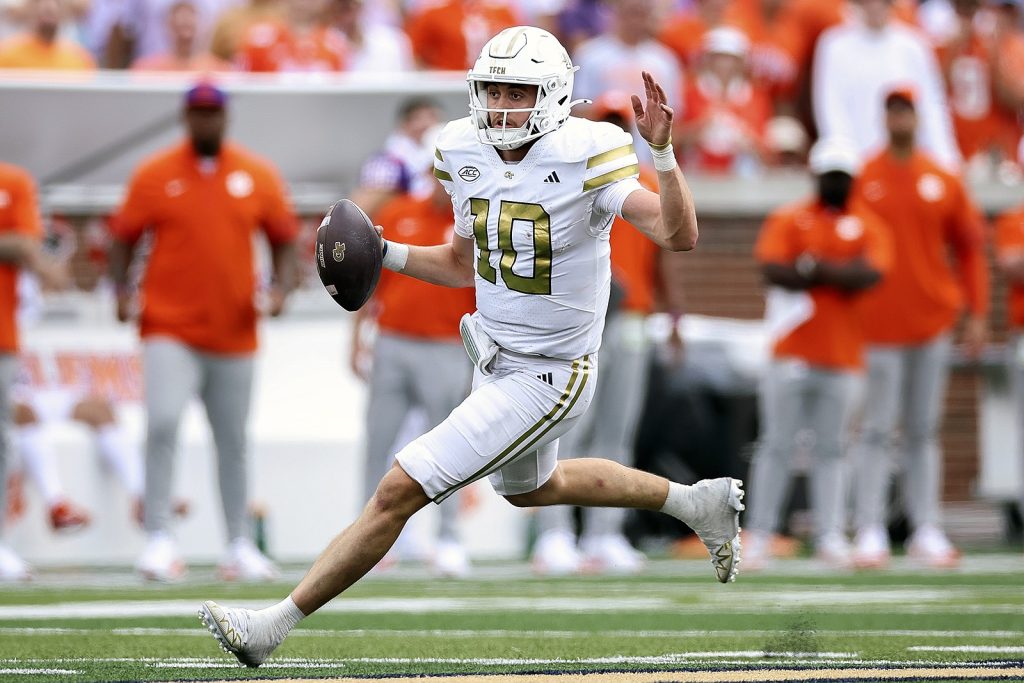
King is a legitimate dual-threat option at 6’2″ with elite speed and a strong deep ball. He threw for nearly 3,000 yards and 14 touchdowns last season while adding 953 yards and 15 touchdowns on the ground. His escapability and pocket awareness — combined with a reputation for performing in high-pressure moments (game-winning drives against Boston College, Colorado, and 12th-ranked Clemson, as well as a 74-yard touchdown drive in 27 seconds to upset Miami in 2023) — make him an intriguing developmental prospect. The playing style parallels draw some interesting comparisons to Drake Maye.
There are legitimate concerns. His short and intermediate accuracy needs work, and his lean frame and tendency to run raise durability questions at the NFL level. That said, as a final-round developmental quarterback, the upside is well worth the selection.
Final Thoughts
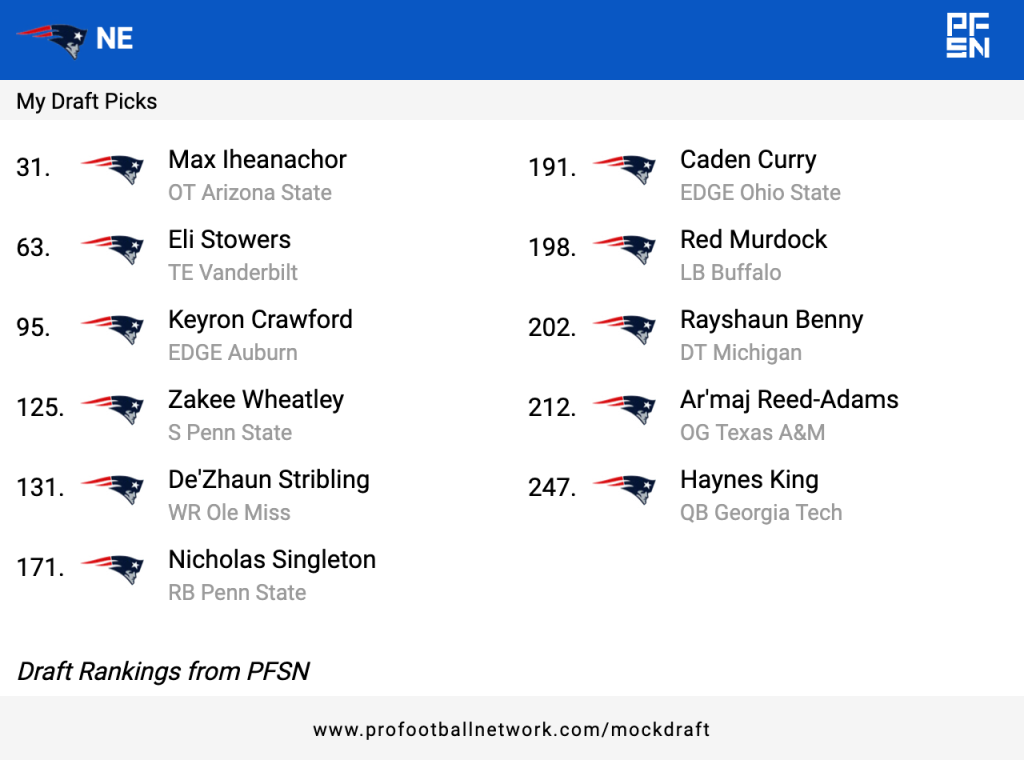
That wraps up my second mock and first full-draft exercise. A few closing observations worth noting.
The most significant constraint in this mock was the absence of trades — the Patriots entered with 11 picks and used all of them, which almost certainly won’t reflect how the actual draft unfolds. While I’m genuinely pleased with many of the players I landed, the board didn’t break entirely in my favor.
The pick I’m least satisfied with is Nicholas Singleton at 171. While I like Singleton, I was also tracking LB Keyshaun Elliott from Arizona State and Guard Jeremiah Wright at that point in the draft, and I gambled that one of them would still be available at 191. Neither was. In hindsight, I would have taken Elliott at 171 and returned to running back later in the draft.
I plan to run at least one more mock before the draft — this time with trades factored in to better approximate what New England is actually likely to do on draft weekend.
About The Author